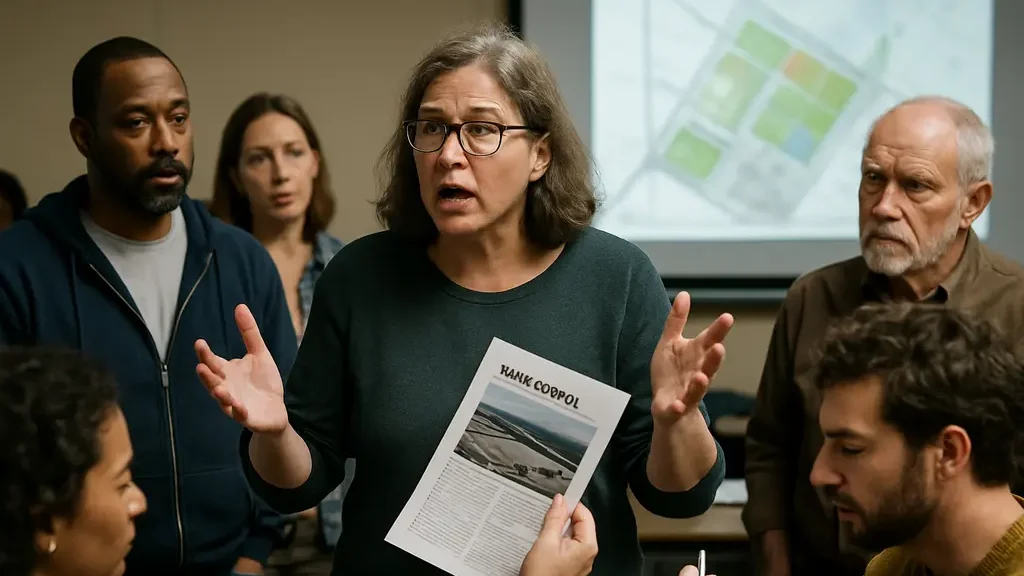
Data Center Opposition is now a planning variable for developers, local officials, utilities, and event teams that convene public meetings. The issue is not simply whether residents support or reject a project. Recent cases show that public concern can change schedules, force new evidence into the record, alter zoning decisions, and, in some cases, stop projects after significant preparation.
Between January 2024 and May 2026, at least 46 AI data center projects across 20 U.S. states were delayed, withdrawn, or blocked due to community opposition, representing more than $170 billion in announced investment, according to Carbon Direct analysis. That figure should be read carefully: it reflects announced investment connected to affected projects, not confirmed losses. Even with that caution, it shows that local approval processes have become material to project execution.
Why Public Meetings Became Project Risk Controls
From Notice To Evidence
Public meetings have moved beyond basic notice and comment. In contested data center cases, residents often ask for concrete information on power demand, water use, backup generation, air emissions, building height, noise, traffic, tax agreements, and emergency planning. A meeting that only presents site renderings or broad economic claims is likely to leave major questions unanswered.
For an industry events specialist, the lesson is direct: the meeting format must fit the technical concerns. A single microphone line after a long slide deck rarely produces useful records. Better sessions separate claims into categories, assign knowledgeable speakers to each category, and show what evidence is confirmed, what remains under review, and which agency has decision authority. This does not guarantee agreement, but it lowers the risk that residents see the process as performative.
Why Telecom And Cloud Stakeholders Should Pay Attention
Data centers are part of the infrastructure chain that supports AI services, cloud platforms, telecom traffic exchange, enterprise software, and security operations. Local siting disputes can therefore affect more than one developer or municipality. Utilities may need to explain load planning. Network providers may need to address fiber routes and service continuity. Local officials may need to explain which concerns belong in zoning, which belong in environmental permitting, and which are outside municipal authority.
Security is a separate but related communication issue. Communities sometimes raise broad concerns about digital risk without a clear link to land-use approval. Meeting organizers can keep that discussion focused by distinguishing cybersecurity education from site-specific permitting evidence. For general consumer security reading, this online antivirus resource offers related information, but it should not substitute for project-specific controls, vendor assessments, or local emergency planning.
How Data Center Opposition Changes Project Reviews
Data Center Opposition Starts Before The Hearing
As of September 25, 2026, 408 U.S. data center sites were listed as under opposition, including 69 in litigation, 135 facing organized opposition, 204 under active debate, and 139.1 GW of planned capacity contested, according to the contested data center tracker. The mix of litigation, organized campaigns, and active debate shows that public response often begins before a final vote. By the time a hearing occurs, residents may already have circulated petitions, compared documents, consulted outside groups, or challenged the project narrative.
Recent project examples in the research notes point to several recurring pressure points. In New Mexico, the proposed Green Data Socorro Campus was cancelled in June 2026 after months of opposition from ranchers and environmental advocates. In Millville, New Jersey, commissioners adopted a citywide ban on new data centers on May 19, 2026, blocking the A1 Data Center Campus. In Virginia, large proposals in Hanover and Glen Allen were cancelled or denied in early to mid-2026 after opposition tied to visual scale, infrastructure strain, and rezoning concerns.
Those examples do not prove that every data center proposal faces the same risk. Local conditions differ sharply. A project near existing industrial land, with available grid capacity and clear environmental records, may face a different reception than a project near homes, farms, stressed water systems, or disputed transmission capacity. Still, the pattern suggests that event design and evidence quality can affect whether a project review remains orderly or becomes a broader referendum on regional growth.
Moratoriums Show The Cost Of Late Engagement
Moratoriums are one of the clearest signs that trust has weakened. They give local officials time to study zoning, utility demand, environmental questions, and fiscal terms, but they can also signal that existing procedures were not built for the scale or technical profile of modern data center proposals. A related analysis of data center moratoriums and local energy explains how power, water, and siting concerns are changing approval practices.
For public engagement teams, the practical lesson is to start earlier than the statutory minimum. If the first community session occurs after site control, utility planning, and tax negotiations are already far advanced, residents may see the process as already decided. Earlier briefings can expose missing information before opposition hardens, but they must include real constraints. If grid upgrades, backup generation, or water demand are not yet settled, the answer should be stated plainly rather than softened into public-relations language.
Event Opportunities For Better Community Evidence

Design Meetings Around The Questions Residents Ask
Data Center Opposition is also shifting what counts as a credible public event. The most useful forums are not designed to win applause. They are designed to build an accurate public record, identify unresolved technical issues, and give decision-makers a basis for comparing benefits against costs. That standard serves residents, developers, and local officials because it reduces confusion over who said what and which commitments were actually made.
For recent projects, the concerns reported in the research notes were not abstract. Residents objected to building height, noise, air and water quality, land-use deviation, infrastructure strain, gas turbine emissions, and rezoning. These are concrete topics that require documented answers. A planning board cannot evaluate noise with slogans. A neighborhood cannot assess air concerns without permit details. A utility cannot address load growth without clear assumptions about timing and capacity.
- Publish a question log before and after each meeting, with owners assigned for unanswered items.
- Separate technical stations for energy, water, air, noise, traffic, zoning, emergency response, and community benefits.
- Record which commitments are voluntary, which are permit conditions, and which are enforceable by ordinance or contract.
- Invite agency staff to explain process boundaries without asking them to advocate for or against the project.
- Use plain-language summaries, but keep technical appendices available for residents who want to review the record.
Professional Growth For Conveners And Technical Staff
The rise of contested infrastructure creates professional development needs for people who run hearings, workshops, briefings, and industry forums. Moderators need enough technical fluency to separate a grid-capacity question from a ratepayer-cost question. Engineers need practice explaining uncertainty without sounding evasive. Local officials need records that can withstand public scrutiny if a decision is later challenged.
For telecom and cloud professionals, this is a community engagement skill set, not just a permitting skill set. Fiber, power, cooling, backup systems, and site security all intersect in a data center project. Teams that can explain these links clearly are better positioned to participate in public forums without overstating certainty or minimizing resident concerns. That is especially relevant where AI workloads have made data center demand more visible to communities.
Data Center Opposition Lessons For Project Forums
Data Center Opposition should be treated as a signal about process quality, technical disclosure, and local trust. It should not be treated as a uniform rejection of infrastructure. Some objections may be resolved through design changes, enforceable operating limits, clearer benefit agreements, or better siting. Other objections may reveal conflicts that are too significant for a project to proceed as proposed.
The strongest event strategy is evidence-first. Conveners should identify what has changed since earlier meetings, what remains uncertain, and what decision is being requested on a specific date. They should avoid framing residents as uninformed if residents are asking for evidence that has not yet been presented. They should also avoid implying that job creation, tax revenue, or digital demand automatically answers questions about power, water, noise, emissions, or land use.
For developers, the lesson is to build engagement into project planning before the first formal hearing. For local officials, it is to set clear meeting rules, publish records, and require consistent documentation. For residents, it is to focus objections on verifiable claims and decision points. When project forums work well, they do not remove conflict. They make the conflict specific enough for accountable decisions.