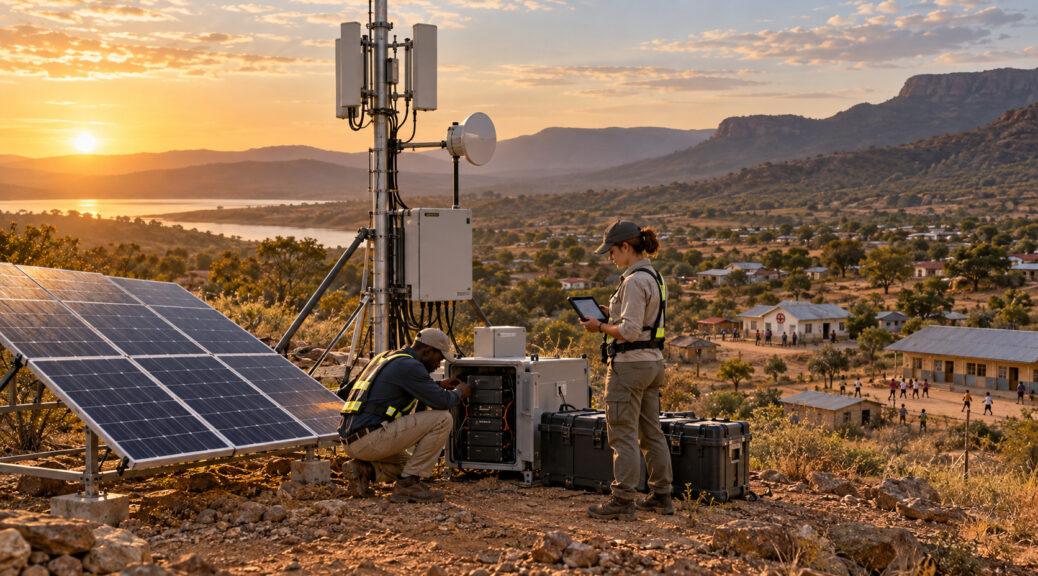
Solar powered 5G sites are starting to look less like a sustainability experiment and more like a practical deployment option where conventional mobile infrastructure is slow or expensive to build. A new U Mobile and ZTE proof of concept in East Malaysia combined solar generation, battery storage, satellite backhaul and lightweight radio infrastructure into a site that operated without grid electricity or terrestrial fiber.
The significance is not simply that solar panels can power telecom equipment. Operators have done that for years. The change is removing several deployment dependencies at once, creating a site that can be transported, powered and backhauled without waiting for the usual tower, utility and fiber sequence.
Solar Powered 5G Sites Remove Two Major Dependencies
A rural mobile site normally needs two supporting systems before its radio layer becomes useful: reliable power and a connection back to the operator’s core network. Difficult terrain, sparse populations and long construction routes can make both expensive.
U Mobile’s September 22 trial targeted those constraints directly. At two locations in Sarawak and Sabah, a lightweight 12-meter pole supported 4G and 5G service, solar panels supplied power, batteries provided backup, and satellite backhaul connected the sites to the core network. The operator’s off-grid 5G trial details state that the battery system can operate for up to 52 hours without sunlight, depending on configuration.
That combination creates infrastructure independence. A site does not have to wait for utility service or a terrestrial transmission route before an operator can test whether local demand warrants a longer-term build.
The Architecture Separates Power From Transport
Solar generation handles the energy requirement. Battery storage bridges periods without sufficient generation. Satellite provides transport where fiber or microwave backhaul is unavailable.
Each dependency can therefore be engineered separately. A location with good radio coverage potential but no grid connection does not automatically become unserviceable. The same applies where trenching fiber would be slow or uneconomic.
Portable 5G over satellite backhaul has also been demonstrated elsewhere. An earlier 5G satellite backhaul demonstration connected a portable 5G radio system through a low-Earth-orbit satellite link, showing how terrestrial radio access can operate without terrestrial transport.
The architecture can be viewed as four connected layers:
| Layer | Portable-site approach | Operational purpose |
|---|---|---|
| Radio access | Lightweight 4G/5G equipment | Provides local mobile coverage |
| Site structure | Compact pole instead of conventional tower | Reduces civil-work requirements |
| Power | Solar panels plus battery storage | Removes dependence on grid power |
| Backhaul | Satellite connection | Removes dependence on terrestrial fiber |
The value comes from the combination. Replacing only the tower or power source can still leave an operator waiting on other parts of the build.
A Three-Day Trial Changes the Deployment Question
U Mobile said the proof-of-concept sites could be installed and fully activated within three days. It contrasted that with difficult rural tower projects that can take close to a year when site acquisition, construction, transmission and grid-power preparation are required.
That comparison is not a universal deployment timetable. Permanent sites differ by permitting, terrain, capacity requirements, weather exposure and local regulations. But it identifies the potential advantage: time to usable coverage becomes something operators can actively design around.
During live testing, the sites supported both 4G and 5G and reached peak download speeds of up to 134 Mbps. That does not establish long-term capacity under sustained traffic, but it demonstrates that a portable architecture can deliver more than basic emergency connectivity.
For operators evaluating rural broadband options, this adds another question to the usual fiber-versus-wireless decision: can lightweight infrastructure establish useful service before a full permanent build makes economic sense?
Remote Communities Are Only One Possible Use
The obvious application is a community where extending fiber and grid power costs too much relative to the expected subscriber base. Portability becomes even more valuable when the need for coverage is temporary or unpredictable.
Disaster recovery is one example. Floods, storms, fires or earthquakes can damage commercial power and terrestrial backhaul simultaneously. A site arriving with its own energy source and satellite transport could restore local mobile coverage while permanent infrastructure is repaired.
Construction zones, remote industrial projects and seasonal operations present a similar problem. Coverage may be necessary for months rather than decades, making a conventional tower and fixed transmission route disproportionate to the requirement.
The model also enables coverage before commitment. An operator could establish service, measure actual usage and then determine whether the location justifies fiber, microwave transport, a larger structure or additional radio capacity.
Economics and Reliability Will Decide Whether It Scales
A successful proof of concept does not prove commercial viability. Operators still need to compare equipment, satellite capacity, batteries, maintenance, security, weather resistance and site visits against the lifecycle cost of a conventional deployment.
Satellite backhaul brings constraints of its own. Capacity, latency, congestion, antenna visibility and service pricing can become more important as traffic grows. Solar sizing and battery reserves also need to reflect local weather rather than average sunshine assumptions.
Maintenance may be the overlooked variable. A site designed to avoid expensive construction can still become costly if technicians must travel frequently to replace batteries, clean panels or troubleshoot satellite equipment. Low-touch operation may matter almost as much as low-touch installation.
The economic test is therefore total cost per reliable unit of coverage, not simply how quickly equipment can be switched on.
The Next Proof Point Is Repeatable Operation
The next useful evidence will be less dramatic than the first installation. Operators should watch uptime through cloudy and wet periods, battery degradation, satellite performance under sustained traffic, maintenance frequency and cost per covered user.
Commercial deployments will also need to establish whether the architecture works best as permanent rural infrastructure, emergency capacity or a bridge until conventional transmission and power become available.
That is why solar powered 5G sites deserve attention now. Their strongest advantage may not be environmental branding but removing buildout bottlenecks that keep remote, disrupted or temporary locations offline.
If operators can demonstrate dependable performance and manageable lifecycle costs, portable off-grid 5G could become another standard network-planning tool—not a replacement for towers, fiber or the power grid, but a way to provide useful coverage without waiting for all three.
Frequently asked questions
What is a solar powered 5G site?
A solar powered 5G site uses photovoltaic panels and battery storage to operate radio equipment without depending entirely on conventional grid electricity. Satellite, microwave or fiber can provide the site’s backhaul connection.
Why would a 5G site use satellite backhaul?
Satellite backhaul can connect a remote base station to the wider telecom network where fiber or microwave infrastructure is unavailable, damaged or too expensive to install for the expected level of demand.
Can portable solar 5G sites replace conventional towers?
Not in every situation. Conventional towers remain better suited to many permanent, high-capacity deployments. Portable off-grid sites are particularly useful where construction, grid access, terrestrial backhaul or deployment time creates a major constraint.