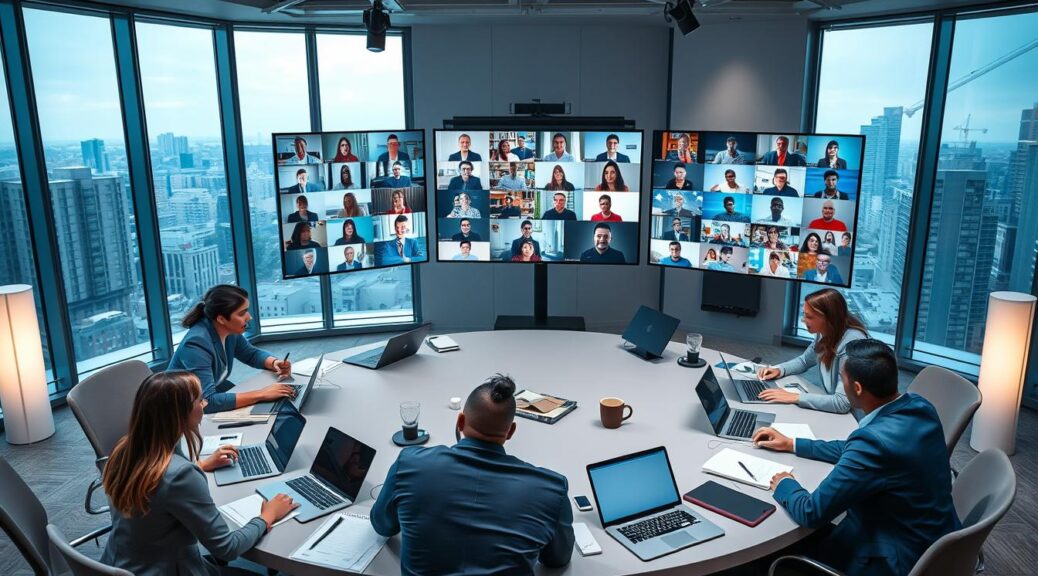
Do you remember those old conference rooms with bad coffee and name tags that wouldn’t stick? We’ve moved beyond that. Today’s gatherings are about more than just getting through a few handshakes.
Now, hybrid telecom conferences mark a big change. They’re not just a leftover from the pandemic. They’re the new way we connect and talk about the future of networks.
This guide isn’t about just adding a webcam to a podium. It’s about finding the right balance between the real, in-person experience and the global reach of digital events. We’re diving into the practical steps to make it happen.
Think of this as a mix of strategy and a warning about common mistakes. We’ll use analysis and a bit of humor to guide you. Our aim is to help your next event be not just good, but formidable.
For telecom digital events to succeed, we need to rethink everything. From how we engage with the audience to the tech we use, it’s a complete overhaul of what a professional meeting can be.
Hybrid Event Technology Requirements
Forget about ‘solutions’ and ‘platforms’ for a moment. What you’re really assembling is the central nervous system of your entire hybrid telecom conference. A failure here isn’t a minor glitch. It’s a reputational black hole that swallows budgets and goodwill alike. Your technology stack determines whether you’re hosting a seamless global conversation or presiding over a digital train wreck.
Let’s dissect the non-negotiables. You need three core systems working in concert, each performing a specific, critical function. Get this wrong, and your event becomes a case study in what not to do.
1. The Event Management Brain: This is your command center for the bureaucratic ballet. We’re talking about software that handles scheduling, marketing, registration, and ticketing with frightening efficiency. The best systems offer Salesforce integrations, dedicated member portals, and analytics that tell you more than just who showed up. Does it streamline the attendee journey from first click to final feedback? That’s the question.
2. The Virtual Experience Hub: Platforms like Remo, Hopin, or Zoom are more than broadcast tools. They are the digital venue. This is where remote attendees live, network, and engage. The key differentiator isn’t the ability to stream video. It’s the capacity to foster spontaneous conversations, host interactive Q&A sessions, and replicate the hallway track online.
3. The A/V & Streaming Core: This is the production studio. Professional-grade cameras, crisp audio mixers, reliable encoders, and robust streaming software (think OBS or vMix) are mandatory. Your A/V setup should be so good it would make a film director nod in approval. Then, you need cloud storage that’s both secure and instantly accessible for on-demand content.
| Technology Component | Primary Function | Key Features to Demand | Critical Questions to Ask |
|---|---|---|---|
| Event Management Platform | Orchestrates logistics, registration, and communication | CRM integration, automated workflows, real-time analytics dashboard | Can it handle tiered pricing and complex access rules seamlessly? |
| Virtual Experience Hub | Serves as the digital venue for remote attendees | Breakout rooms, networking lounges, interactive polls, sponsor booths | Where’s the networking? Is engagement baked in or an afterthought? |
| A/V & Streaming Core | Produces and delivers high-fidelity video/audio content | Redundant internet lines, 4K capable cameras, professional audio mixing | Is the Wi-Fi robust enough for 4K streaming with 500 people live-tweeting? |
| Data & Analytics Layer | Provides insights into attendee behavior and event ROI | Engagement heatmaps, content popularity metrics, lead generation tracking | Does it offer insights beyond simple headcounts? Can you measure sentiment? |
That last row in the table is critical. The Wi-Fi question isn’t hypothetical. I’ve seen a corporate keynote stutter because the venue’s network couldn’t handle simultaneous streaming and social media traffic. You need enterprise-grade, dedicated bandwidth with a backup connection. Test it under load, not during setup when the room is empty.
Also, data is your compass. A modern platform for hybrid events should tell you which sessions had the highest virtual engagement, which sponsors generated the most leads, and where attendees dropped off. This isn’t vanity metrics. It’s the intelligence that shapes your next conference.
Choosing your technology, then, becomes a philosophical exercise. Are you building a passive broadcast or an interactive symposium? Your tech stack is the answer. It silently declares what kind of experience you value for both your in-person audience and your global, virtual participants. For a successful hybrid telecom conference, every piece must be chosen with that singular experience in mind.
Balancing In-Person and Virtual Experiences
Imagine a keynote speaker giving a great insight, but half the audience feels like they’re watching through aquarium glass. This is the silent failure of most hybrid telecom conferences. We’re not just bridging physical distances; we’re navigating psychological chasms.
The grand experiment often collapses under its own ambition. Virtual attendees feel like they’re watching a party they weren’t invited to. In-person participants enjoy the champagne and canapés of spontaneous connection.
Here’s the uncomfortable truth: balance isn’t a 50/50 split. It’s a 100/100 commitment. You need two complete experiences that feel equally valuable, not two halves of one compromised whole.
Source 3 nails it with their core best practice: “Design Experiences for Both Audiences.” Not one experience with add-ons. Not a main event with a virtual annex. Two deliberately crafted journeys that intersect meaningfully.
The Psychological Architecture of Inclusion
Let’s talk about the VP sipping coffee in Dallas versus the engineer watching from Lisbon. Same content, radically different context. The “aha!” moment should land with equal force on both sides of the screen.
How do we architect this psychological parity?
- Dual-track consciousness: Every decision—from session length to Q&A format—must pass through two filters: “How does this work in the room?” and “How does this work on a 13-inch laptop?”
- Micro-moments of recognition: Virtual attendees need their presence acknowledged regularly. Not just at the beginning with a generic “hello to our online friends.”
- Equivalent access points: If in-person attendees can approach the speaker during a break, remote participants need a comparable pathway.
Source 1 offers a counterintuitive tactic: limit in-person attendance. This isn’t about exclusivity. It’s about optimization. A packed physical venue often leads to neglected virtual participants.
By capping the room, you force design decisions that serve both audiences equally. The scarcity becomes a creative constraint that improves the experience for everyone.
The Engagement Asymmetry Problem
Source 2 highlights the stark contrast in engagement opportunities. In-person attendees enjoy:
- Serendipitous hallway conversations
- Physical exhibitor interactions
- Body language reading during sessions
- Informal meal networking
Virtual participants typically get:
- A chat box (often ignored)
- Pre-recorded video tours
- Static PDF downloads
- That haunting “Be Right Back” screen
This asymmetry creates what I call “digital jet lag”—the disorienting feeling of being present but not participating.
Tactical Solutions for Cohesive Experiences
So how do we build hybrid telecom conferences that feel unified?
| Challenge | In-Person Solution | Virtual Solution | Unifying Element |
|---|---|---|---|
| Networking Breaks | Physical lounge with refreshments | Speed networking rooms with video | Shared icebreaker prompts |
| Q&A Sessions | Microphones in aisles | Upvoted questions in platform | Moderator integrates both sources |
| Exhibition Hall | Booth visits with demos | Virtual reality booth tours | QR codes linking to digital content |
| Keynote Delivery | Stage presence and visuals | Close-up camera angles | Interactive polls for all attendees |
Tailored content is your secret weapon. Some sessions work better as in-person experiences with virtual observation. Others should be designed as digital-first with in-person participation as bonus.
Consider these hybrid-specific formats:
- “Digital Fishbowl” sessions: Small in-person group debates with virtual attendees providing real-time research and data via chat
- “Global Roundtable” discussions: Physical participants at venue tables joined by virtual participants on tablet screens at each table
- “Cross-platform workshops: Hands-on activities where physical and digital tools complement each other
The 100/100 Commitment in Action
Let’s return to that keynote example. The speaker isn’t just addressing a room. They’re performing for two distinct audiences simultaneously.
Smart production uses:
- Dedicated camera operators focusing on audience reactions for virtual viewers
- Real-time chat highlights displayed on venue screens
- Virtual attendee questions given equal priority
- Physical gestures that translate well to camera
The most successful hybrid telecom conferences create what I call “experience osmosis.” Energy flows between physical and digital spaces seamlessly. A laugh in the venue sparks emoji reactions online. A virtual poll result surprises the in-person crowd.
This isn’t about perfection. It’s about intentionality. Every element—from registration to farewell—must be examined through both lenses.
The engineer in Lisbon should finish the day feeling they attended the same conference as the VP in Dallas. Not a lesser version. Not a delayed broadcast. The same conference, experienced differently but valued equally.
That’s the balancing act that transforms hybrid telecom conferences from technical experiments into meaningful gatherings. The scale doesn’t measure physical versus digital. It measures engagement versus exclusion.
Registration and Ticketing Strategies
Your registration page is like the velvet rope outside an exclusive club. It should create excitement, not frustration. For hybrid telecom conferences, it’s more than just collecting names. It sets the tone for the attendee journey. Get it wrong, and it feels like handing out bad flyers.
The key is integrated. Your registration platform should be easy to use. It shouldn’t require attendees to create another password they’ll forget. Modern solutions like Eventbrite, Cvent, or Bizzabo make everything easy. This shows respect for your audience’s time.
Tiered ticketing is where strategy meets psychology. In-person access might cost more. But it’s worth it for the serendipitous hallway conversations that spark deals. Be clear about what you’re selling.
Here’s a look at common ticketing structures for hybrid telecom conferences. Each tier offers a different value proposition and targets a specific attendee mindset.
| Ticket Tier | Primary Audience | Key Features | Strategic Goal |
|---|---|---|---|
| Virtual Basic | Global professionals, budget-conscious | Live stream access, digital handouts, basic Q&A | Maximize reach & inclusivity |
| Virtual Premium | Remote power users, international teams | All basic features + on-demand replay, networking lounges, speaker chats | Increase virtual ticket revenue |
| In-Person Standard | Local attendees, regional partners | Full venue access, catering, physical swag, main sessions | Fill venue capacity |
| In-Person VIP | Sponsors, C-suite, speakers | All standard features + premium lounge, priority seating, exclusive dinners | Drive high-margin revenue & sponsor satisfaction |
The scarcity principle works for in-person tickets. Limiting caps creates urgency. But your venue and experience must feel exclusive. A half-empty ballroom looks sad, like a party nobody wanted to attend.
Virtual tickets should focus on inclusivity. Affordable passes remove barriers. This expands your audience for hybrid telecom conferences. It’s about making content accessible.
Early-bird offers are more than just a cash-flow tactic. They’re a market research tool. They show who’s most engaged before you’ve printed a single badge.
Package deals need creative thought. Why not offer a virtual team pass or a “conference plus certification” combo? The best hybrid telecom conferences use ticketing to solve business problems, not just sell admission.
Budget considerations force tough choices. A robust hybrid platform costs money. Should those costs be in all tickets, or should virtual tickets subsidize the in-person experience? It depends on your goals. Is this a revenue play or a brand-building exercise?
Your registration form is your first major data harvest. Every field is a choice. Ask for too much, and you’ll see abandonment rates spike. Ask for too little, and you’re flying blind. Prioritize: name, email, company, role. Maybe ticket type. Save the “favorite telecom innovation of the last decade” for a post-event survey.
This segmentation from the first click allows for personalized journeys. Virtual attendees get emails about platform testing and time zone schedules. In-person attendees get venue maps and packing tips. This thoughtful curation starts with your registration strategy, making each participant feel seen before they even arrive.
Ultimately, ticketing for these events is less about transactions and more about orchestration. You’re not just selling a seat; you’re allocating experiences, managing expectations, and building communities across two parallel dimensions. Get your registration strategy right, and the rest of your hybrid telecom conference planning falls into place with surprising elegance.
Live Streaming and Virtual Platform Setup
Imagine a telecom event with a poor stream. It’s like flat soda at a champagne tasting—it misses the point. In hybrid telecom conferences, your live stream is the main event for half your audience. It needs to be as important as the physical event, or remote attendees will feel left out.
Let’s move past the “just hit go live” idea. Professional virtual conferencing needs a studio approach. This means using multiple cameras and dedicated streaming hardware. Your presenter’s laptop webcam won’t cut it. You also need a dedicated audio engineer to ensure your keynote sounds great.
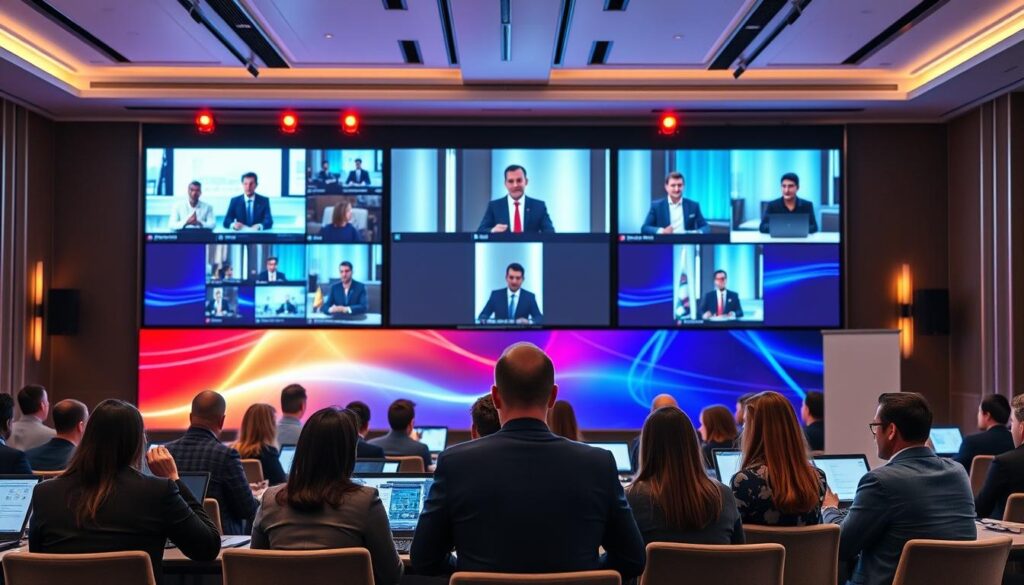
Technical requirements are strict. You need stable, redundant streams and the ability to simulcast without issues. Your A/V quality must be top-notch. Invest in a tech support team ready to solve problems quickly.
Your virtual platform should be more than a webinar portal. It should be an immersive digital space. It needs a digital town square for networking and easy navigation. Interactive tools should feel natural, not added as an afterthought.
Think of your platform as a digital twin of your event. Session rooms should flow smoothly, and sponsor booths should be interactive. The chat, Q&A, and polling features should be part of the experience. For more on what makes a good platform, check out this hybrid event platform guide.
The key is to blend production and platform seamlessly. Your director should call shots that work well on screen. The stream should feel like part of the virtual environment, not separate. This creates an experience, not just a broadcast.
In the end, successful virtual conferencing for hybrid telecom conferences shows respect. Respect for your audience’s time and intelligence. Get it right, and you’re not just streaming content—you’re building a bridge between worlds.
Interactive Features for Remote Attendees
Let’s be honest: emoji reactions in a chat window feel like digital applause. For hybrid telecom conferences, passive viewing is a no-go. Your remote audience wants to connect, debate, and do business.
To bridge the digital divide, we need more than basic features. We need a strategic engagement toolkit. It’s about creating spaces where conversation flows.
Live Q&A with Virtual Priority is essential. Moderation software ensures online attendees’ questions are heard. It’s like affirmative action for the digital crowd.
Real-time polls are powerful. They turn a monologue into a dialogue instantly. Asking questions like “Which emerging standard poses the biggest security risk?” and showing the results shapes the session.
Then, there are breakout rooms. These virtual hallways allow for focused discussions. They turn scribbled notes into shared documents.
Source 2 suggests virtual networking lounges. Schedule them like coffee breaks. Use AI to match attendees based on profiles and interests. No one wants another awkward Zoom silence.
Even camera management during breaks matters, as Source 1 notes. Show the room mingling. Let the virtual crowd feel the energy. It’s a small detail with a big impact.
But is a feature-packed platform enough? Or is it just digital busywork? True interactivity must have a tangible outcome.
A poll that ends with a graph is just entertainment. A poll that changes the speaker’s talk is engagement. A chat full of jokes is distraction. A chat that leads to a deep dive is value.
We need a framework to design beyond the click. The goal is to turn remote attendees into participants with agency. The table below moves from common features to strategic outcomes.
| Feature | Common Use | Strategic, Outcome-Focused Use | Tangible Outcome |
|---|---|---|---|
| Live Chat | General commentary, emoji reactions | Moderated channel for speaker Q&A; themed channels for specific sessions | Curated list of top questions addressed live; persistent thread for post-session follow-up |
| Virtual Breakout Rooms | Random small group assignment | Pre-topic selection with dedicated moderators and a shared output doc | A collaborative summary or problem-solving proposal presented back to the main stage |
| Gamification / Polls | Trivia quizzes, simple opinion polls | Live case-study voting that determines the next discussion segment; ranking of industry priorities | Session content adapts in real-time; aggregated data report shared with all attendees post-event |
| Networking Lounge | Open video chat room | Speed-networking sessions with timed rotations; sponsor-led “solution room” discussions | Attendees leave with 5-10 new direct contacts; lead generation for sponsors with clear intent |
Designing a successful hybrid telecom conference means focusing on outcomes. It asks: what will the remote attendee leave with that they didn’t have before? A new contact? A resolved technical doubt? A vote that shaped the agenda?
When you frame interactivity this way, every feature becomes a means to an end. The software is just the stage. The conversation is the show.
Time Zone and Global Considerations
Forget buffering streams; the ultimate lag in a hybrid telecom conferences is the Earth’s rotation. You’re not just coordinating speakers and slides. You’re creating a single moment across a planet split into two dozen time zones. Your 2 PM keynote is someone’s 2 AM bedtime story.
So, how do you host a global event without asking half your audience to pull an all-nighter?

The answer lies in a strategic blend of live magic and evergreen content. The dream of global accessibility—a key benefit of the hybrid model—demands you become a master of chronological chess. You must decide what deserves a “prime time” slot and what thrives on demand.
Let’s talk about the prime time compromise. You pick a broadcast window that’s inconvenient for everyone, but catastrophic for no one. Think 9 AM EST for a US-Europe-India friendly session. It’s late for Asia, early for the West Coast, but workable for most.
You schedule your must-see, interactive panels here. The rest? You liberate them from the clock.
This is where on-demand content isn’t a backup; it’s your primary diplomacy tool. Record every session with high production value. This transforms your event from a fleeting moment into a persistent resource.
An attendee in Singapore can watch the “prime time” panel with their morning coffee, then dive into other sessions at their leisure. This replay capability is the cornerstone of true global reach.
But what about networking? Live mingling across continents is a fantasy. The solution is asynchronous networking. Think AI-powered matchmaking algorithms that suggest connections based on profiles and interests, then let them schedule a 1:1 video chat at a mutually human hour.
Or, create forum-based discussion threads for each session that remain active for weeks. Conversation doesn’t have to be real-time to be real.
So, what’s the winning strategy? There isn’t one single answer, but a menu of approaches based on your audience distribution.
| Strategy | Core Approach | Best For |
|---|---|---|
| Prime Time Compromise | Schedule key live events in a window that minimizes global pain. | Conferences with a dominant attendee bloc in 2-3 regions. |
| On-Demand Focus | Treat all content as recorded, with “live” Q&A sessions held separately in regional blocks. | Highly technical hybrid telecom conferences where content review is key. |
| Follow-the-Sun Relay | Host a continuous 24-hour event, passing the “live” baton between regional hubs. | Brands aiming for a monumental, always-on global spectacle. |
| Regional Hub Model | Host simultaneous mini-events in key cities, linked virtually for shared keynotes. | Organizations with strong local partners and a desire for in-person energy worldwide. |
The “follow-the-sun” model is quite audacious. Imagine a keynote kicking off in Singapore, followed by deep-dive panels from Berlin, rounding out with innovation talks from San Francisco. It’s exhausting to produce but creates an unbeatable sense of global momentum.
It declares your event isn’t *in* a time zone; it *transcends* them.
In the end, mastering time zones isn’t a technical check-box. It’s the highest form of attendee respect. It acknowledges that while your content is global, your attendees are local—with local bedtimes, work hours, and lives.
A successful hybrid telecom conference doesn’t fight the clock. It designs an experience that works gracefully within its relentless tick.
Sponsor Integration Across Platforms
Sponsors aren’t just giving money out of kindness. They want access, influence, and leads. Your job is to show them a good return on their investment in both the physical and digital worlds.
The old way of sponsoring feels outdated now. In today’s world, sponsors want experiences that work both online and offline. They want a digital echo for every handshake.
The key is tiered sponsorship packages that work on both platforms. Think of them as a menu where physical and digital parts are together, not apart. This makes sponsors more than just advertisers.
For example, a top package might include a prime booth and a special virtual “product lounge” in the app. A lower package could offer a live demo that’s streamed online with a Q&A chat.
The magic happens when you mix things up. A breakfast roundtable becomes a virtual chat. A swag bag gets digital coupons and special online content. Every physical thing has a digital match.
Here’s how tiered packages can add value:
| Package Tier | Physical Assets | Digital Assets | Data & Analytics |
|---|---|---|---|
| Platinum | Keynote intro, premier booth, sponsored lunch | Virtual main stage banner, featured product lounge, push notifications | Full engagement dashboard, lead scoring, post-event attendee list |
| Gold | Standard booth, session sponsorship, printed materials | Virtual booth, sponsored breakout stream, banner ads | Booth traffic reports, content download metrics, connection data |
| Silver | Tabletop display, logo in program | Logo in virtual lobby, listing in sponsor directory | Basic attendance metrics, post-event summary report |
Hybrid telecom conferences offer sponsors something special: data. It’s not just about people walking by booths. Now, you can track time in demos, downloads, and lead quality.
This data is incredibly valuable. It turns vague “brand awareness” into real numbers. You’re showing sponsors how their money is working, not just guessing.
The next step is to curate these interactions. Not every digital touchpoint is valuable. Guide sponsors to features that spark real business talks. Think video chats instead of ads, and live demos with polls instead of sales pitches.
Good integration turns sponsors into partners. They help create content and drive engagement, not just write checks. When done right, it funds your event and builds relationships for the future.
In the end, hybrid sponsorship is about speaking the sponsor’s language: results, metrics, and ROI. Show them that, and they’ll likely fund your next event without a problem.
Content Delivery Optimization
Smart hybrid telecom conferences know something key. The event doesn’t end when the last speaker leaves. That’s when the real broadcast starts. Your content then enters its most valuable phase: immortality.
Record every session. Create an on-demand library. This isn’t just for those who missed the early keynote. It’s a new asset. Think of it as your intellectual property’s second act.
A dense technical panel on network slicing can become a series of blog posts. A visionary keynote can turn into a podcast episode. Demo videos can become sales tools.
Look at the programming for an event like IEEE Globecom 2025. The depth is staggering. Now imagine each session living on, reaching audiences months later. That’s the power move.
This is where hybrid telecom conferences squeeze every drop of value from their gathered brainpower. The live event creates the signal. The optimized content delivery ensures that signal never fades to static. It keeps broadcasting, educating, and generating returns long after the venue lights go dark.