
In today’s fast world, keeping up is key. For Northern Oklahoma College and field teams, a research-backed methodology is becoming essential. It involves small groups working together to solve problems and share knowledge.
Studies show these sessions cut down on “social loafing” and increase personal responsibility. This leads to better team results. It supports NOC’s goal of quality education and its value of Personalized Education.
These groups face big challenges head-on. They break down barriers that stop teams from working together. They also solve technical or procedural issues faster.
This method is a powerful engine for internal upskilling. It changes how teams grow. It builds a cycle of shared knowledge and skill development. This is the base for a more agile and quick-to-respond organization.
One‑Page Charter: goals, cadence, 45‑minute agenda
Creating a clear One-Page Charter is the first step to a high-impact learning circle. It moves your team from casual brown bags to a disciplined practice of continuous improvement. Without it, meetings lack direction and fail to address the concrete and immediate needs of your NOC and field engineers.
Your charter acts as a social contract. It aligns every participant from the start. Research shows that defining clear goals is key for adult learning. Your One-Page Charter does just that.
Start with one primary objective. This goal must be specific and measurable. For example, “Reduce mean time to repair (MTTR) for Tier-2 network incidents by 15% within one quarter.” This clarity turns learning into a strategic tool.
Frame this goal as a SMART objective. It should align with your team’s performance metrics. This connection to real-world outcomes creates accountability. It also gets leadership support by showing clear value.
Lock in a Fixed Cadence
Consistency breeds results. Choose a recurring schedule and stick to it. A bi-weekly cadence is often ideal for NOC teams. It provides regular touchpoints without overwhelming daily operations.
- Creates a reliable rhythm for knowledge sharing.
- Allows time to apply learnings between sessions.
- Builds the habit into the team’s workflow.
Publish this schedule for the entire quarter. Treat these meetings as unbreakable commitments. This predictability is key to maintaining momentum.
Engineer a 45‑Minute Agenda
Time is a non-renewable resource. A strict, repeatable agenda maximizes it. The following 45-minute template ensures focus and efficiency:
- 5-min Check-in: Quick round-table on current work challenges.
- 25-min Core Topic: Deep dive on a pre-selected incident, tool, or procedure.
- 10-min Action Planning: Decide on one concrete step to apply the learning.
- 5-min Wrap-up: Assign follow-ups and confirm the next meeting’s topic.
This structure prevents scope creep. It respects participants’ time while delivering concentrated value. The final five minutes are key for maintaining continuity between sessions.
The table below highlights the stark difference between a charter-driven circle and an informal session:
| Element | Charter-Driven Learning Circle | Informal Brown Bag |
|---|---|---|
| Purpose | Clear, SMART goal aligned to metrics (e.g., reduce MTTR). | Vague or shifting topic based on recent events. |
| Structure | Fixed, timed 45-minute agenda repeated every session. | Open-ended discussion with no time limits. |
| Cadence | Bi-weekly, scheduled quarters in advance. | Ad-hoc, scheduled only when someone has an idea. |
| Outcome | Documented action items and measurable progress toward a goal. | General conversation with few tangible next steps. |
| Participant Commitment | High, due to shared social contract and clear value. | Low, often viewed as optional or a distraction. |
Creating your One-Page Charter is the most critical action you will take. It converts intention into execution. This document ensures your Peer Learning Circle is a strategic asset, not just another meeting. It sets the stage for everything that follows.
Rotating Roles: facilitator, scribe, timekeeper
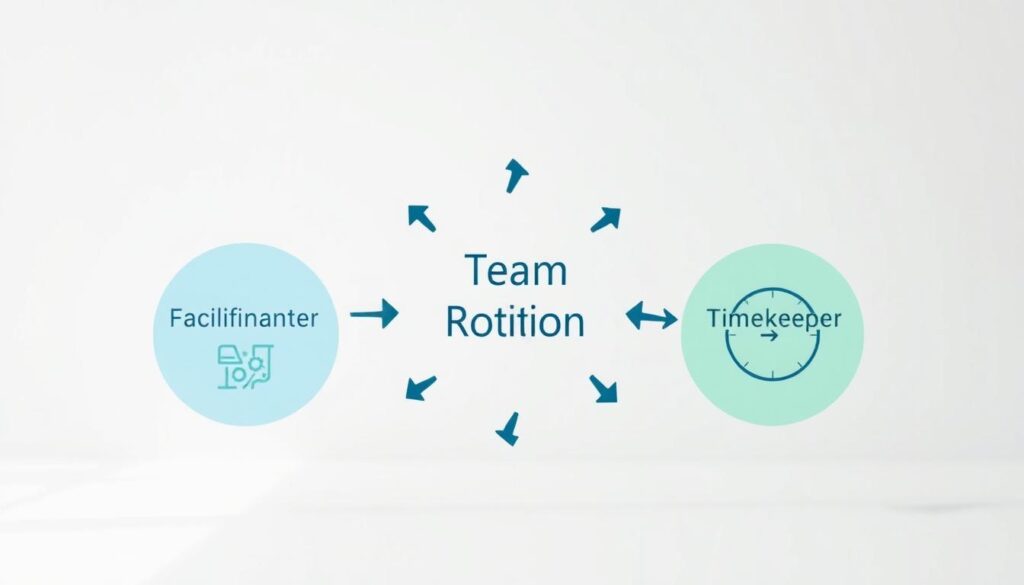
The secret to a lively learning circle is in the three key roles: facilitator, scribe, and timekeeper. This rotation each session is essential, not just a suggestion. It makes the meeting active and helps everyone learn.
Each role has important tasks that keep the circle on track.
- Facilitator: Leads the discussion, asks questions, and makes sure everyone speaks. They control the conversation flow.
- Scribe: Writes down important decisions, technical details, and action steps. They keep a shared note.
- Timekeeper: Watches the agenda, warns about time, and keeps the team on schedule. They protect the plan.
Studies like the CATME peer evaluation tool show this structure works. CATME looks at skills like “facilitating the contribution of others” and “keeping the team on track.” These match the facilitator and timekeeper roles, showing why circles succeed.
A set role rotation schedule stops one person from dominating or getting tired. The facilitator changes each meeting. Scribe and timekeeper roles can switch or merge, depending on the team size. This way, everyone feels involved.
| Role | Primary Duty | Skill Developed | CATME Correlation |
|---|---|---|---|
| Facilitator | Guide discussion & ensure participation | Leadership & communication | “Facilitating the contribution of others” |
| Scribe | Document insights & action items | Active listening & concise writing | “Contributing to the team’s work” |
| Timekeeper | Enforce agenda timing | Meeting discipline & prioritization | “Keeping the team on track” |
This rotating model has big benefits. It spreads leadership skills across the team. Young engineers get to practice leading in a safe space. It also makes everyone good at leading, writing, and managing time.
Most importantly, it stops meetings from getting boring. If one person always leads, they might get tired. But when roles change, everyone stays interested because they have a new leader to follow.
This method is all about teamwork. It turns your learning circle into a place where everyone grows. Just by changing who leads, you create a culture where everyone leads and grows together.
Repeatable Agendas: incident reviews, lab shares, tool demos
A predictable agenda is key to a successful learning program. Without reliable formats, circles can lose momentum. Adult learners do well with problem-solving and task-oriented learning. Your agendas should meet this need.
This section gives you the plan for your meeting content. We share three formats to boost value and keep people engaged.
Deep-Dive Incident Reviews (Case Reviews)
Incident reviews, or case reviews, focus on past problems. They aim to learn, not place blame. A set format guides the discussion from start to solution.
This format helps adult learners solve problems. It turns firefighting into system improvement. Each review builds a shared understanding and keeps team knowledge up-to-date.
Hands-On Lab Shares & Focused Tool Demos
Lab Shares and Tool Demos are great for skill-building. A Lab Share is a peer-led demo of a new method. It’s hands-on learning.
Tool Demos dive into a specific feature of a system. They are short, lightning talks that give engineers new skills.
The table below compares these agenda types. It helps you pick the right format for each session.
| Agenda Format | Primary Focus | Typical Format | Ideal For | Key Outcome |
|---|---|---|---|---|
| Incident Review | Reactive Analysis & Prevention | Structured post-mortem walkthrough | After a major outage or recurring error | Documented lessons learned, updated runbooks |
| Lab Share | Proactive Skill Transfer | Live demonstration or walkthrough | Sharing a new script, config template, or debug method | Increased cross-coverage, standardized practices |
| Tool Demo | Feature Proficiency & Adoption | Focused lightning talk on a specific tool | Onboarding to a new platform or exploring an advanced feature | Higher tool utilization, efficient problem-solving |
Creating a Sustainable Learning Cycle
Sequencing these formats is key. A mix of reactive and proactive sessions works best. Plan a monthly schedule with one incident review and one lab share or tool demo.
This mix keeps learning fresh and effective. It ensures a cycle of learning and improvement. This variety is essential for scaling facilitation practices across teams.
Let facilitators pick from this menu. A quarter might include two case reviews, a lab share, and a lightning talk. This mix keeps your Peer Learning Circle impactful and valuable.
Measure Impact: MTTR trends, cross‑coverage, cert passes
Effective circles measure success in three main areas: operational, cultural, and developmental. This data-driven method turns peer learning into a powerful tool for improvement. It shows the value of circles and helps secure resources.
Success is measured against high standards. By linking circle activities to outcomes, you ensure ongoing growth.
Track three Key Performance Indicators (KPIs) to see your circle’s full impact.

Operational Metrics: Mean Time to Repair (MTTR) Trends. This shows how fast teams solve problems. Look at MTTR for specific issues discussed in the circle. A decrease means you’re winning.
Cultural/Team Metrics: Cross‑Coverage Capability. See if team members can handle new tasks. Survey them to check if they feel confident in other roles. An increase means the circle is breaking down barriers.
Developmental Metrics: Certification Pass Rates. Use the circle to help team members get certified. Track who passes and compare before and after the circle. Rising numbers mean team members are growing faster.
Start by setting a baseline for each KPI. Then, track progress regularly, like every quarter.
Share this data in leadership meetings. Use it to improve your circle’s focus. If MTTR isn’t improving, spend more time on deep analysis. If cross-coverage is low, add more lab sessions.
This cycle makes your Peer Learning Circle a strategic asset. It brings undeniable value to your team and operations.
Starter Kit: invites, deck, follow‑up notes
Start your first Peer Learning Circle with a Starter Kit. It has everything you need to move from idea to action. It’s perfect for your NOC and Field Teams.
Begin with a standard invitation template. Add the one-page charter to the calendar invite. This makes everyone clear on the Circle’s goals and schedule.
A pre-made slide deck sets up your first meeting. It follows a 45-minute plan, introduces roles, and guides your discussion. For example, it might cover a tool demo.
Include a quick-start guide in your deck for “training to use media tools.” A brief slide on video conferencing and shared documents helps everyone get started.
Use a follow-up notes template after each session. It captures learnings, decisions, and tasks with owners. This turns talks into documented knowledge and keeps everyone accountable.
For easy access to help and materials, use your current systems. Put the Starter Kit on a platform like NOC’s learning management system. This makes it easy for everyone to find what they need.
With this kit, your Peer Learning Circle becomes a regular, valuable part of your routine. It builds a culture of shared knowledge that boosts your network and field operations.