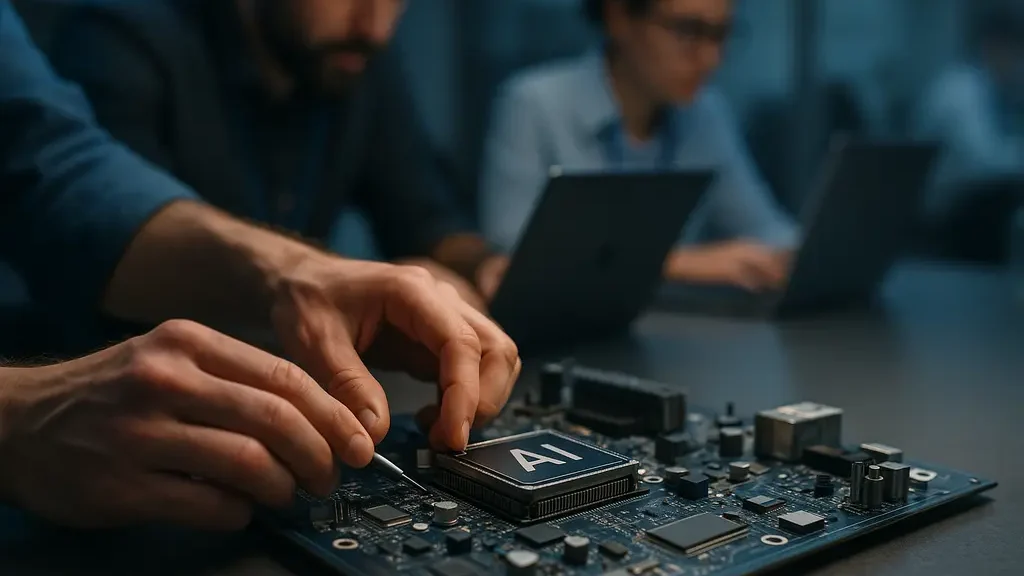
AI Chip Technology is shifting from a general accelerator story to a more specific question: which workloads justify custom silicon, and which organizations have the operating discipline to use it well? OpenAI’s Jalapeño announcement is relevant because it focuses on inference for large language models rather than only model training, where much of the public attention has been concentrated.
For telecom strategists, community technology leaders, and professionals planning their next … Read the rest
AT&T’s Open AI Model is best viewed as an operational signal rather than a broad AI claim. The available evidence points to a telecom-specific model effort tied to network data analysis, open collaboration, and lower-friction experimentation across operators, vendors, researchers, and developers. For telecom professionals, the more practical question is not whether AI will replace network expertise. It is which data, evaluation, governance, and automation skills become more valuable as … Read the rest
AI inference technologies are moving from a secondary planning topic to a central design constraint for modern data centers. The change is not simply that AI models are larger or that more servers are being ordered. The more durable shift is that trained models must now answer user requests repeatedly, often with tight latency, cost, and power limits. That makes inference a continuing operational load rather than a one-time training … Read the rest
Enterprise AI adoption is moving from conference-stage ambition toward harder network design questions: where inference runs, how private 5G fits edge sites, whether Ethernet fabrics can carry AI traffic predictably, and who owns long-term operations. Nvidia’s recent developments give enterprise and telecom teams useful signals, but they do not remove the need for disciplined assessment.
For event planners and community organizers in telecom, the practical issue is not whether AI … Read the rest
The AI chip partnership between OpenAI and Broadcom is best understood as an infrastructure signal, not just a semiconductor headline. OpenAI and Broadcom announced a multi-year collaboration to co-develop and deploy 10 gigawatts of OpenAI-designed AI accelerators and networking systems, with rack deployments scheduled to begin in the second half of 2026 and conclude by the end of 2029, according to OpenAI’s announcement.
For technology infrastructure events, this creates … Read the rest
Custom AI chips have moved from a specialist semiconductor topic into a board-level infrastructure question. The evidence is still concentrated in a small number of large-scale announcements, but the direction is clear enough for technical leaders, telecom operators, cloud buyers, and professional development teams to prepare. The issue is not whether every company should design silicon. Most should not. The practical question is how organizations should evaluate custom accelerator projects, … Read the rest
Agentic AI Infrastructure is now less about a single accelerator and more about whether compute, storage, networking, financing, software controls, and operations can work as one deployable system. Nvidia’s recent announcements point in that direction, but enterprises should read them as infrastructure signals rather than proof that production-grade AI agents are simple to operate.
The change matters because agentic systems place different pressure on infrastructure than many earlier generative AI … Read the rest
AT&T’s Open AI Telco Model work is notable because it ties model development, telco-specific training data, and accelerator infrastructure into one production-oriented program. The available reporting points to OTel 2.0, an open-source model built for telecommunications tasks, using AMD Instinct GPUs and AMD’s ROCm software platform across training and inference. The technical signal is not that general-purpose AI has been replaced. It is that a major carrier is testing whether … Read the rest
T-Mobile’s U.S. workforce reduction is not just another round of telecom layoffs. It is a useful signal about which telecom career skills are becoming more valuable as operators simplify organizations, automate more work, and expect smaller teams to support increasingly complex networks.
Deutsche Telekom’s first-half 2026 figures show T-Mobile US headcount falling from 70,036 employees at the end of 2025 to 65,365 on June 30, a decline of 4,671 positions, … Read the rest
Getting your proposal picked from a crowded call for papers can be tough. The competition is fierce, mainly in fast fields like telecom.
First, know who you’re talking to. Are you speaking to Python developers or DevOps engineers? You need to get the talk level right: beginner, intermediate, or advanced.
Topics like 5G, IoT security, and network automation are popular. But, too much complexity can lead to rejection. Keep … Read the rest