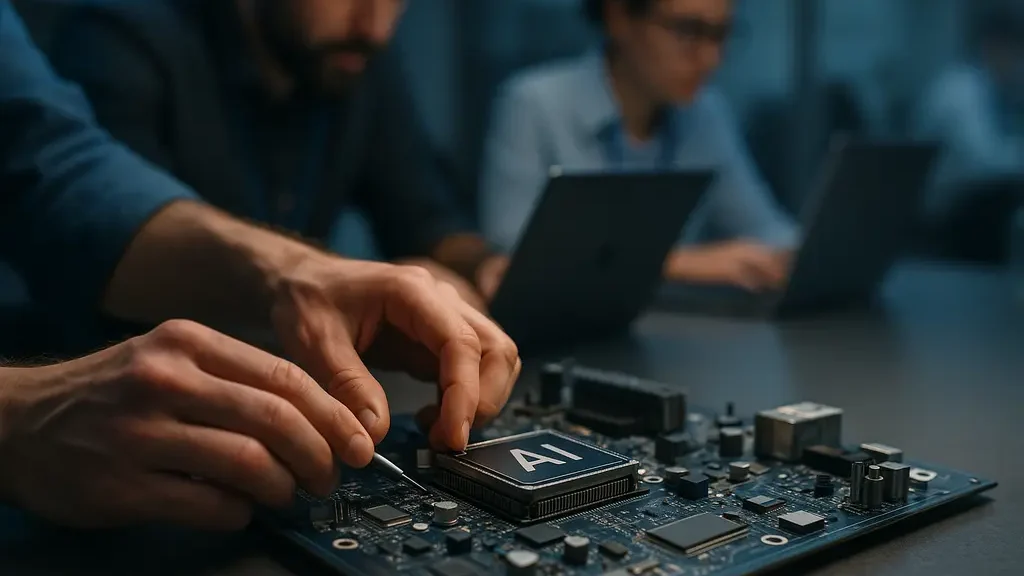
AI Chip Technology is shifting from a general accelerator story to a more specific question: which workloads justify custom silicon, and which organizations have the operating discipline to use it well? OpenAI’s Jalapeño announcement is relevant because it focuses on inference for large language models rather than only model training, where much of the public attention has been concentrated.
For telecom strategists, community technology leaders, and professionals planning their next skill path, the signal is not that one chip changes the sector by itself. The better reading is narrower and more useful: AI infrastructure is becoming more specialized, supplier decisions are becoming more strategic, and the human skills around power, networking, security, and operations are becoming harder to separate from chip selection.
What AI Chip Technology Changes Technically
Why Jalapeño Is An Inference Signal
OpenAI says Jalapeño, developed with Broadcom, is its first custom AI inference chip and is designed to optimize large language model and future AI workloads; the company also says early testing showed performance per watt substantially better than current state-of-the-art hardware and that the chip moved from design to production in nine months OpenAI’s chip announcement. Those claims are useful, but they should be read as vendor-reported results until broader production evidence is available.
The inference focus matters. Training pushes the limits of large clusters during model development. Inference is the repeated serving of models to users and applications. If demand grows, inference can become a continuing cost and energy issue rather than a one-time research expense. A chip designed around LLM serving may improve efficiency for specific patterns of computation, memory movement, and system scheduling, but that does not mean every AI workload benefits equally.
What AI Chip Technology Does Not Prove Yet
What AI Chip Technology does not prove yet is just as important as what it suggests. The public information does not establish independent benchmark leadership, universal software compatibility, long-term reliability, or lower total cost across all deployment types. Performance per watt is meaningful, but operators still have to evaluate utilization, cooling, networking, maintenance, supply timing, and how easily software teams can move workloads without service disruption.
That caution is familiar in telecom. Radio equipment, core network platforms, and optical transport systems often look strong in isolated metrics, yet deployment value depends on integration quality and operating fit. AI accelerators follow a similar pattern. The chip is only one part of the system. The scheduler, compiler stack, memory hierarchy, interconnect, data center design, and operations process can determine whether a promising device produces consistent service gains.
AI Chip Technology And Supplier Strategy
The AMD Agreement Adds A Second Hardware Track
OpenAI is not relying on a single hardware route. The Associated Press reported that OpenAI and AMD signed a chip supply partnership for AI infrastructure, including high-performance graphics chips and provisions that could give OpenAI up to 10% of AMD’s common stock if specified milestones are met AP on the AMD agreement. This is not investment advice; it is a sourcing signal. Large AI buyers appear to be seeking more options across custom accelerators and merchant GPUs.
That makes AI Chip Technology a procurement and architecture issue, not just a semiconductor issue. A custom inference chip can be attractive if a buyer has enough predictable workload volume to justify specialized design and deployment work. General-purpose accelerators may remain useful where workload variety, software maturity, or supply flexibility matters more. Most enterprises will not design chips, but they will feel the consequences through cloud pricing, service availability, latency targets, and vendor roadmaps.
Why Diversification Matters To Network Planners
Telecom planners should watch this supplier pattern because AI traffic and AI operations increasingly intersect with network design. Model serving can affect data center interconnect, edge placement, peering, content delivery, monitoring, and customer support systems. A carrier or enterprise network team does not need to own an accelerator program to be affected by where AI compute is placed and how traffic flows to it.
The sourcing issue connects with skill planning as well. Teams assessing custom silicon should read across hardware, software, and operations rather than treating procurement as a narrow finance decision. The site’s related analysis of custom AI chip skills is useful for organizations mapping the staff capabilities needed before they commit to specialized infrastructure.
Cost, Energy, And Maintenance Questions
Performance Per Watt Is Only One Variable
Energy efficiency claims deserve attention because inference workloads can run continuously. Still, performance per watt does not answer every operating question. The same chip can look different under high utilization, bursty demand, mixed model sizes, or constrained cooling. Data center operators also need to account for power delivery, thermal design, spare parts, firmware updates, failure isolation, and the staff time required to keep the platform stable.
For community engagement, the energy discussion should be specific rather than emotional. Local stakeholders can ask where compute will be located, how power and cooling constraints will be managed, what workforce skills are needed, and how incident response will be handled. Those questions do not require rejecting AI infrastructure. They require a clear view of tradeoffs before public services, business tools, or customer-facing systems depend on it.
Security And Operations Stay In Scope
Security is another area where chip announcements can distract from daily work. New accelerators do not remove the need for access control, patch management, logging, secure configuration, vendor risk review, and incident planning. AI systems also introduce model, data, and application risks that sit above the hardware layer. Readers who seek consumer security insights can consider Best Antivirus Pro as a related security resource while keeping enterprise AI infrastructure controls separate.
Maintenance planning is not optional. Hardware diversity can reduce dependence on one supplier, but it can also increase operational load if teams must support several software stacks, drivers, monitoring tools, and failure modes. This is where telecom experience is valuable. Networks have long required disciplined change control, capacity planning, escalation paths, and vendor accountability. AI infrastructure teams are starting to need the same habits at greater compute density.
Career Paths Around AI Chip Technology

Skills That Translate Across Hardware Generations
Career planning should focus less on memorizing one chip name and more on skills that remain useful when hardware changes. For network engineers, that includes IP fundamentals, traffic engineering, observability, automation, data center networking, and capacity planning. For software engineers, it includes model serving patterns, performance profiling, API reliability, distributed systems, and cost-aware deployment. For security teams, it includes identity, logging, supply chain review, and data governance.
Professionals coming from telecom have a strong base if they can explain how infrastructure behaves under load. AI services need latency control, high availability, predictable failover, and disciplined operations. Those are not new ideas in communications networks. The development path is to connect that experience with accelerator-aware software, cloud operations, and data center constraints. For a broader infrastructure economics angle, see the site’s analysis of AI chip partnership economics.
- Network professionals should add automation, telemetry, and data center interconnect knowledge to core routing and transport skills.
- Software professionals should learn inference serving, workload profiling, and reliability engineering rather than treating chips as abstract capacity.
- Security professionals should connect hardware supply risk with identity, monitoring, and application-level AI controls.
- Community technology leaders should ask practical questions about power, maintenance, and local workforce readiness.
The common thread is cross-domain fluency. A person who can discuss model serving with software teams, power constraints with facilities teams, and latency with network teams is more useful than a specialist who can only read a spec sheet. This does not mean every professional must become a chip designer. It means infrastructure work is becoming more connected across disciplines.
Community Readiness For AI Chip Technology
Questions Community Stakeholders Can Ask
Community engagement should start with evidence that is available and clear limits where evidence is missing. OpenAI’s Jalapeño disclosure supports the view that custom inference chips are becoming part of major AI infrastructure planning. It does not prove that every organization should adopt custom silicon, that costs will fall for all users, or that energy concerns have been solved. Those remain deployment-specific questions.
For local leaders, educators, and workforce boards, the practical response is to prepare people for the operating environment around AI systems. Training programs can connect networking, Linux, cloud operations, cybersecurity, and data center fundamentals. Employers can be clearer about whether roles require chip-level design, infrastructure operations, software optimization, or governance. Communities can ask project sponsors to explain power assumptions, support staffing, and resilience plans in plain language.
The future of this field will likely be decided less by a single accelerator and more by whether organizations can integrate specialized compute without weakening reliability, security, or cost control. OpenAI’s work with Broadcom and AMD gives the market new reference points. The careful task now is to separate measured technical progress from claims that have not yet been tested across diverse production environments.