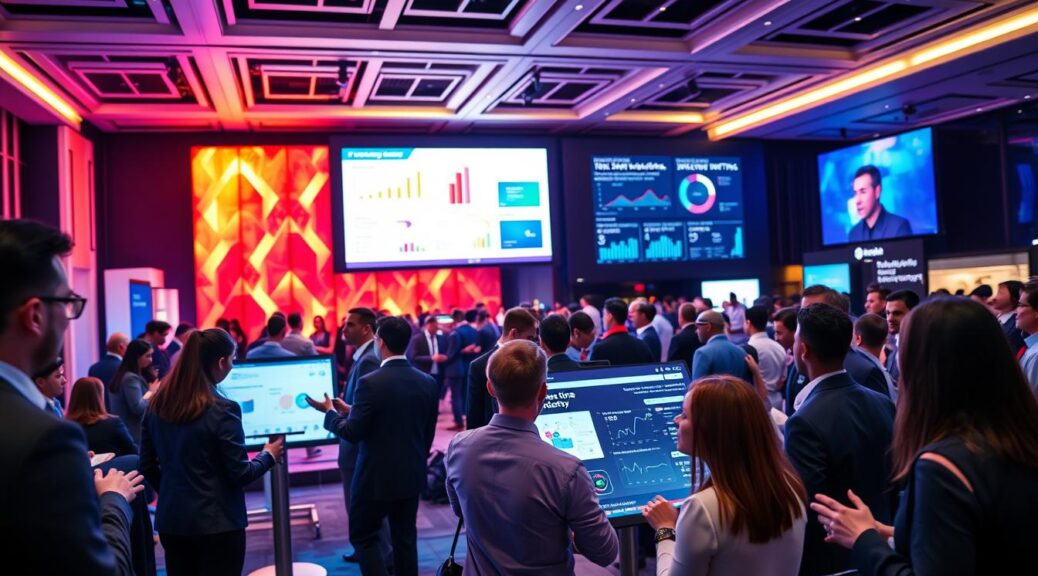
Remember when industry conferences were all about bad coffee and boring PowerPoint slides? Those days are over. The old days of dial-up modems and passive listening are gone.
Now, professional gatherings are more than just meetings. They’re immersive brand experiences that need real-time data. Think of them as the user interface for your whole corporate strategy.
This change is like what’s happening in networks. Just as operations moved to event-driven architecture, so must our conferences. Platforms that handle everything from registration to virtual stages are key.
They turn attendee behavior into useful insights. It’s the difference between sending a message and having a real conversation. The right stack doesn’t just host an event; it makes every connection stronger.
Mobile Event Apps for Telecoms
In the telecom world, where connections are key, it’s surprising to see events stuck with old tools. The sector that brings us 5G and global data networks often uses paper schedules and scattered communication. It’s like building a high-tech network but then using old-fashioned methods for the launch.
Mobile event apps change this. They’re not just digital brochures anymore. They turn smartphones into powerful tools for engagement. Every attendee has it, making it a central hub for your event.
Platforms like Dreamcast offer a single solution for all types of events. They handle in-person, virtual, and hybrid events smoothly. Telecom pros get one platform for everything, no more juggling different systems.
These conference apps are becoming more than just tools. They’re key for getting and keeping customers. Every interaction in the app gives you valuable data. This includes session check-ins, poll responses, and networking connections.
This data is your advantage. In telecom, keeping customers is a big challenge. A good event app helps you see what works. You’ll know which demos were hits and which speakers were favorites. You’ll also find out which clients were most engaged.
The features go beyond basic navigation. You get interactive floor plans, real-time polling, and secure meeting schedulers. All this is wrapped in a design that shows off your company’s innovation.
Networking is another big plus. Telecom is all about partnerships and building ecosystems. A smart app can connect the right people. It turns chance meetings into valuable connections.
For you, the organizer, this is huge. The app gives you real-time feedback. You know what content works and who’s networking. This info shapes your future events and marketing plans.
Don’t see the mobile app as an extra. In today’s telecom world, it’s essential. It’s how you get leads, show your expertise, and build a community. A good conference app is the heart of your event.
Live Streaming and Hybrid Events
If the telecom industry’s product is connectivity, then a purely physical event is ironic. The pandemic showed us the need for a hybrid model. It exposed our old, location-bound thinking.
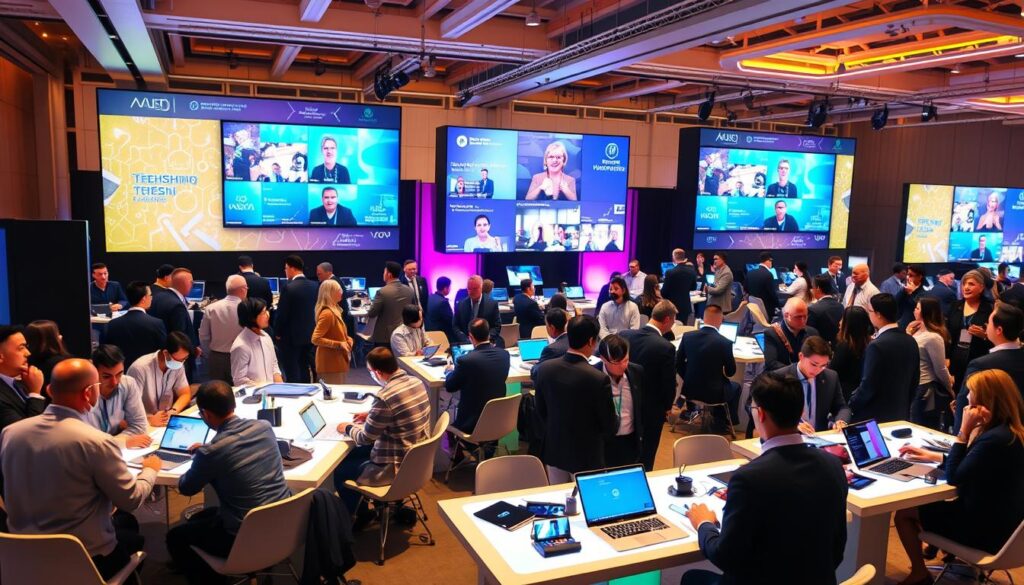
A hybrid event is not just an option. It’s a must for proving your concept. We’re moving beyond just streaming. We’re building a live media network.
The Parity of Experience Problem
Your hybrid event is a big content delivery challenge. You need a clear, 4K stream for remote CTOs without buffering. You also have to manage polls and Q&A for many virtual attendees.
The goal is to make everyone feel equal. Virtual attendees shouldn’t feel like they’re watching a security camera. This is where the real challenge starts.
Beyond the Broadcast: Building a Virtual Venue
Seamless streaming is just the start. The event happens in the virtual space you create. You need networking platforms that are more than an afterthought.
You need digital lounges for spontaneous talks. And virtual coffee chats that match the energy of in-person ones. Your virtual networking platforms are the main stage for your audience.
Architecting Your Hybrid Network
This is like the infrastructure your company sells. It’s about smart routing and adapting in real-time. Your event platform should handle engagement as well as a telco network handles data.
The goal is to make “hybrid” seem natural. The event should feel like it’s happening in the best place for everyone—whether that’s a convention center or home office.
| Component | Physical Event Reality | Virtual Event Reality | The Hybrid Imperative |
|---|---|---|---|
| Content Delivery | High-fidelity, in-person immersion. | Dependent on home internet stability and stream quality. | Invest in professional, multi-bitrate streaming to guarantee a broadcast-grade experience for all. |
| Audience Interaction | Raised hands, direct eye contact, immediate feedback. | Digital hand-raising, chat-based Q&A, emoji reactions. | Use a unified platform that moderates and displays questions from both audiences in real time, creating one conversation. |
| Networking | Organic, hallway conversations and cocktail mixers. | Often clunky, scheduled, or non-existent. | Build dedicated virtual networking platforms with video breakout rooms, AI-powered matchmaking, and gamified connection goals. |
| Technical Backbone | Local AV team and venue Wi-Fi. | Attendee’s home setup and event software. | Treat your event like a CDN: redundant streams, real-time analytics on engagement, and tech support for both worlds. |
Your industry is built on nodes and networks. It’s time for your events to reflect that. Stop hosting gatherings. Start creating connected experiences.
Interactive Polling and Q&A Systems
Think of your event’s Q&A as the heart of your gathering. The old way, with a single microphone, was dull. Now, event tech makes it lively, with everyone’s voice heard.
Spotting bored attendees during long talks is easy. But, interactive tools change that. They check if people get what’s being said, if they’re interested, and if there’s debate.
This isn’t just for fun. It’s about making your event valuable. Every poll answer tells you what to change or what to highlight.
It’s like moving from looking at past data to making decisions now. This tech lets you adjust your event as it happens. In fast-changing telecom, not getting feedback in real-time means you’re missing out.
The old and new ways are very different. Here’s a comparison:
| Aspect | Traditional Q&A | Tech-Enabled Interactive Systems |
|---|---|---|
| Participation | Dominant voices, physical limitation. | Democratic, anonymous, unlimited digital input. |
| Feedback Speed | Delayed, often post-session. | Instantaneous, visible to all in real-time. |
| Data Quality | Anecdotal, hard to quantify. | Structured, quantifiable, rich in sentiment. |
| Actionability | For future event planning. | For live course-correction and immediate lead generation. |
| Audience Comfort | High pressure to speak publicly. | Low-pressure digital engagement increases honesty. |
You’re not just sharing info anymore. You’re leading a discussion. Tools like interactive voice response (IVR) polling make your event dynamic. They show what works, what’s unclear, and what’s sparking debate.
Interactive systems do more than keep people engaged. They give you the real feedback you need. You stop guessing what your audience thinks. You know.
Digital Badge and Lead Capture
The traditional conference badge is outdated. It only shows a name and nothing else. But, the digital badge is different. It’s like a smart spy in your attendee’s pocket, thanks to your conference app.
It’s not just about replacing a lanyard with a QR code. It’s a big change in how we see attendee behavior. A tap at a booth does more than exchange business cards. It logs which product sheet was downloaded and how long someone stayed at a demo.

This combines the physical and digital parts of your event. It makes check-in easy. But the real magic is in the seamless lead capture and the detailed profiles it creates.
Every interaction builds a detailed profile. What kind of data are we talking about?
- Interest Level: Time spent at a demo or exhibit.
- Content Consumption: Whitepapers downloaded, session replays watched.
- Networking Maps: Connections made with other attendees and your team.
- Session Engagement: Attendance and participation in specific workshops.
This raw data is very powerful. But the real magic happens next. This is the “micro-segmentation” engine in action. You’re no longer sending a generic email to everyone who visited a booth.
Instead, you can target specific groups. Like “network architects who spent over five minutes at the edge computing demo, then attended the IoT security roundtable.” This is not just a list of leads. It’s a list of qualified opportunities with context.
For the telecom industry, this technology is a game-changer. It helps sales teams by providing real intelligence, not just contacts. A simple hallway handshake can turn into a meaningful conversation.
The digital badge, through your conference app, turns passive attendance into active, measurable engagement. It’s the ultimate tool for moving beyond mere contact collection to genuine relationship intelligence.
Social Media Integration
Let’s be brutally honest: a telecom conference that doesn’t trend on LinkedIn is just a very expensive, catered meeting. In today’s attention economy, social media integration is key. It turns a closed gathering into an open-source project for industry thought leadership.
This isn’t about slapping a hashtag on the wall and calling it a day. That’s like bringing a flip phone to a 5G summit. True integration is a strategic, multichannel operation. It’s about weaving your event’s narrative into the ongoing professional conversation on key networking platforms.
Think of it this way. Your stage is the primary broadcast. Twitter, LinkedIn, and even Instagram are the powerful rebroadcast towers. A killer keynote quote should be atomized into a shareable graphic. A heated panel debate should spill over into LinkedIn threads, pulling in experts who couldn’t attend physically.
The savvy play, though, goes far beyond broadcasting. It’s about listening. Social listening tools act as a real-time sentiment heatmap. Is that new network slicing demo a hit or a flop? Which speaker is sparking the most conversation? This data is invaluable.
It lets you identify the hidden influencers in your audience and elevate their voices. More importantly, it allows you to engage, correct misconceptions, and double down on what’s working. This strategic listening turns social channels into dynamic, external networking platforms that fuel the event itself.
The ultimate win? You radically extend your event’s lifespan. A three-day conference can generate three weeks of online engagement. Recaps, interview snippets, and attendee debates keep the momentum alive long after the last coffee station is wheeled away.
For the telecom industry, this organic, attendee-driven content is pure marketing gold. It provides authentic proof points that no corporate brochure can match. It turns your attendees into a global advocacy team.
So, how do you cut through the noise? You don’t just add to the chatter; you shape it. Provide visually stunning, pre-formatted content that’s easy to share. Create dedicated spaces for online discussion. Feature the best social posts on screen during breaks. Recognize and reward your most active digital participants.
By treating social media as a core networking platforms for your event, you stop shouting into the void. You start a conversation that resonates across the entire industry.
Virtual Reality Demos and Exhibits
In the telecom world, we sell invisible infrastructure. VR exhibits turn abstract promises into real experiences. Imagine showing engineers your edge computing solution’s fast performance with a headset.
This way, they can see how a multiplayer game runs smoothly on your network. It’s a much more powerful story than charts.
Event tech has become more than just useful. It’s become an art form. Solutions like Dreamcast create immersive learning experiences. For telecom, it’s about building belief.
Industry experts compare it to the connected car analogy. Talking about vehicle analytics is one thing. But imagine letting someone experience it all in a virtual car.
They can interact with the dashboard and see the data flow. It shows how your network makes it all possible, without a real car.
VR demos make the intangible real. They turn spec sheets into sensations.
But VR isn’t for every message. It’s like the IMAX of event tech—powerful but expensive. Use it for your most complex and compelling stories.
- A 5G-coordinated smart factory with a thousand IoT devices
- A remote surgery scenario enabled by your low-latency network
- A smart city traffic management system in action
These stories need depth, scale, and immersion. Flat screens can’t tell them effectively.
Don’t call it the metaverse unless you want eye-rolls. The goal is to prove capability, not chase buzzwords. Your VR demo shows what your network makes possible.
The logistics are important. You need a dedicated space, comfortable headsets, and staff. It’s an active, guided journey.
The payoff is huge. In a crowded telecom market, a compelling VR experience stands out. It’s the ultimate differentiator.
When choosing event tech, think about what’s hard for your audience to grasp. If it’s about scale, real-time interaction, or spatial understanding, VR is your secret weapon. It turns “trust us” into “experience it yourself.”
Virtual reality demos show your confidence in your technology. You’re not just saying your network can handle the future. You’re building it right there on the expo floor. That’s not just event tech—that’s event leadership.
Network Infrastructure Requirements
Your conference apps are only as good as the network they run on. It’s not just about Wi-Fi or hoping the hotel’s internet works. We’re talking about building a system that can handle a lot of data.
Every time someone taps their badge or votes in a poll, it creates a record. These records need to be processed quickly and without losing any data. Can your system handle 10,000 poll responses at once?
Thinking like a network engineer is key. Your event platform needs to be a real-time streaming hub. Technologies like Apache Kafka are essential for this.
Having a hybrid architecture is important. You need to sync data between on-prem registration desks and cloud analytics dashboards smoothly. This is not just a nice-to-have; it’s essential for a successful event.
| Architecture Type | Best For | Scalability | Resilience Level |
|---|---|---|---|
| On-Premises Legacy | Small, internal meetings | Limited | Moderate |
| Cloud-Only | Standard corporate events | High | High |
| Hybrid Cloud-Edge | Large telecom conferences | Extreme | Very High |
| Fully-Managed Service | Mission-critical launches | Elastic | Maximum |
Monitoring your infrastructure is a must. You need alerts before problems happen, not after. Think of it like telcos watching for network storms.
Having strong security and monitoring frameworks is key. They give you the visibility you need for a smooth event.
Your event’s digital backbone needs to be strong. Even the best conference apps can’t save you if your infrastructure is weak.
Security and Data Privacy
We’ve been excited about the cool tools for events. Mobile apps, VR demos, and digital badges are great. But, with great data comes great responsibility. You’re not just hosting a conference; you’re handling a treasure trove.
As the EBM Article points out, telcos have a lot of customer data. Your event adds more: who met whom, what deals were made, and which technologies were seen. This data is not just information. It’s a map of your industry’s future, and it’s a big target.
Think like Kai Waehner’s cyber defense teams. Your event tech needs a SIEM mindset. Are there odd data exports from your platforms? Is someone scraping attendee lists? This isn’t paranoia. It’s necessary.
A single breach can ruin your event’s reputation. The value from lead capture tools? Gone. Trust in your platforms disappears quickly. Encryption, access controls, and clear data policies are essential. They’re not extras; they’re must-haves.
In the end, the best event technology is useless without trust. Security isn’t just a checkbox. It’s the base of everything. Build it well.