Telecommunications operators can introduce 50G-PON services over existing optical distribution infrastructure, but that does not mean every GPON or XGS-PON network is ready for a straightforward upgrade.
The technology provides significantly higher access-network capacity while supporting coexistence with earlier generations of passive optical networks. However, successful deployment depends on optical power budgets, wavelength compatibility, equipment support, interoperability, and how existing subscribers are managed during migration.
Recent updates to International Telecommunication Union (ITU) standards, including a February 2026 amendment covering 50G-PON, give operators more detailed technical options.
Meanwhile, Broadband Forum interoperability testing continues to examine how equipment from different manufacturers performs together.
For fiber broadband providers, the most important question is not simply whether 50G-PON equipment is commercially available.
It is whether the existing network can support the intended upgrade without creating unacceptable optical losses, equipment incompatibilities, or service disruptions.
What the February 2026 50G-PON Standard Changed
50G-PON is a higher-capacity passive optical networking technology designed for applications including residential broadband, business connectivity, and mobile backhaul.
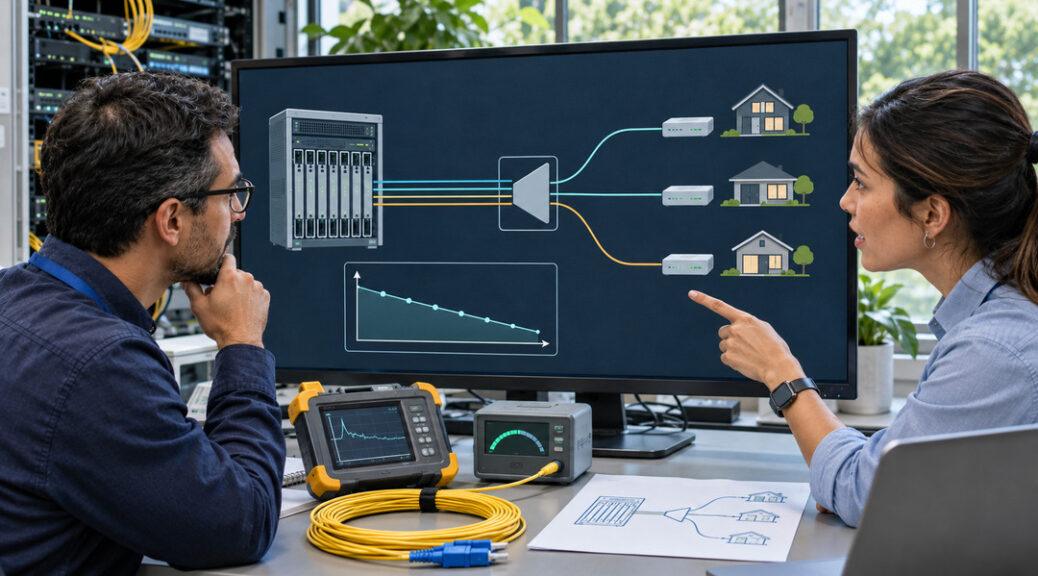
Like earlier PON generations, it uses an optical line terminal (OLT) at the provider’s network facility and optical network units (ONUs) at customer locations.
Between them is an optical distribution network containing fiber, connectors, splitters, and other passive components.
The ITU-T G.9804.3 Amendment 3 specification, approved on February 6, 2026, describes the physical media requirements for 50G-PON. ITU
The technology supports a nominal downstream line rate of 50 Gbit/s, with defined upstream options of 25 Gbit/s and 50 Gbit/s.
The February amendment made several technical changes.
It deprecated the earlier 12.44 Gbit/s upstream option, updated optical path-loss encoding, introduced additional optical power-budget specifications for certain deployment arrangements, and revised parameters relating to upstream wavelength options.
These changes matter because service providers need consistent technical requirements when evaluating optical modules and network equipment.
However, a 50 Gbit/s downstream line rate should not be confused with a guaranteed 50 Gbit/s internet connection for every subscriber.
PON capacity is shared among connected users. The speed that customers experience also depends on service configuration, traffic demand, network equipment, and capacity elsewhere in the provider’s infrastructure.
An operator evaluating 50G-PON therefore needs to distinguish the technology’s nominal line rate from the service performance customers can realistically receive.
Existing GPON and XGS-PON Networks Can Coexist With 50G-PON
One major advantage of higher-speed PON technology is the possibility of reusing existing fiber infrastructure.
A provider may already operate GPON services across thousands of homes.
Some customers may have migrated to XGS-PON, while others continue using their existing GPON connections.
Replacing the entire optical distribution network simply to introduce a newer technology could create substantial construction costs and disruption.
Coexistence offers another approach.
Different PON generations can operate over a shared optical distribution network when the selected architecture and equipment support the necessary wavelength arrangements.
The ITU-T G.9805 coexistence recommendation, updated through Amendment 2 in November 2025, describes three principal coexistence methods: coexistence elements, multi-PON modules, and splitter-based arrangements. ITU
A coexistence element combines or separates optical signals associated with different PON technologies.
A multi-PON module integrates support for multiple generations within a compatible equipment arrangement.
Splitter-based methods provide another way of implementing suitable coexistence architectures.
The standard also addresses optical isolation, filtering, and power-loss specifications.
Its November 2025 amendment added further optical path-loss specifications for arrangements involving GPON, XGS-PON, and 50G-PON.
These details are important because a network that works properly with one generation may not automatically meet the requirements of another.
Coexistence is technically supported, but operators still need to verify that their selected hardware, optical components, and installed fiber plant can implement the intended arrangement.
Optical Power Budgets Can Determine Whether an Upgrade Works
Optical power budgeting is one of the most important technical checks during a PON migration.
Light loses power as it travels through optical fiber and network components.
The amount of loss depends on several factors, including fiber length, connectors, splices, passive splitters, and any coexistence equipment.
The total optical path loss must remain within the limits supported by the selected system.
Adding a coexistence component can introduce additional insertion loss.
That loss may appear small compared with the existing optical network, but it still reduces the available engineering margin.
Consider a hypothetical example.
An operator measures 22.4 dB of optical path loss on an existing distribution route.
The proposed coexistence arrangement is expected to introduce another 1.1 dB.
The resulting estimated loss is:
22.4 dB + 1.1 dB = 23.5 dB
Suppose the selected equipment arrangement supports a hypothetical maximum optical path loss of 25 dB.
The nominal remaining margin would be:
25 dB − 23.5 dB = 1.5 dB
These numbers are illustrative, not specifications for a particular 50G-PON optical interface.
The calculation shows why engineers should not assume that an existing fiber route will support a new technology merely because the cable itself does not need replacing.
The remaining margin must be evaluated against the actual equipment specifications, operating wavelengths, design allowances, and expected changes over the network’s service life.
An operator should also consider whether the chosen configuration leaves adequate allowance for connectors, repairs, environmental conditions, and future maintenance.
A successful existing GPON installation is useful evidence about the fiber plant. It is not proof that every future PON system will meet its optical requirements.
Interoperability Testing Is Improving, but Compatibility Still Needs Proof
Telecommunications providers often purchase network equipment from multiple manufacturers.
This can improve procurement flexibility and reduce dependence on a single supplier.
However, equipment implementing the same general networking technology does not automatically behave identically in every configuration.
The Broadband Forum has been conducting interoperability testing for higher-speed PON systems.
Its May 2025 report on 50G-PON interoperability testing described the technology’s first participation in the organization’s PON Plugfest testing series. Broadband Forum
The February 2025 event at AT&T Labs in Plano, Texas, brought together equipment manufacturers to examine compatibility.
The initial 50G-PON testing focused on the transmission convergence and physical media dependent layers.
These are essential parts of the technology, but successful testing at those layers does not establish complete compatibility across every equipment combination and management function.
The work continued in 2026.
In its Summer 2026 Member Meeting Roundup, Broadband Forum reported that manufacturers tested XGS-PON, 25GS-PON, and 50G-PON implementations at an April interoperability event in France. Broadband Forum
The organization also described ongoing work on PON management data models, ONU conformance testing, and interoperability requirements.
This progress matters for service providers considering future access-network investments.
It demonstrates continuing work toward multivendor compatibility without proving that any particular commercial combination is ready for deployment.
An operator should still obtain evidence for the exact OLT platform, ONU models, software releases, and management functions intended for use.
Five Checks Before Migrating to 50G-PON
A useful 50G PON migration plan should examine more than optical capacity.
The following checks can help operators identify the most important technical and operational dependencies.
| Migration consideration | What operators should verify |
|---|---|
| Existing fiber infrastructure | Actual optical path loss, splitters, connectors, route condition, and remaining engineering margin |
| Coexistence architecture | Supported PON generations, wavelength arrangements, filtering, and optical isolation |
| Equipment compatibility | OLT and ONU interoperability, supported software, provisioning, authentication, and management functions |
| Service requirements | Expected customer demand, shared capacity, upstream needs, and supporting aggregation-network capacity |
| Migration and recovery | Controlled activation procedures, service monitoring, escalation responsibilities, and an approved recovery plan |
These checks are not a replacement for the applicable standards or equipment-specific engineering requirements.
They establish what evidence should be gathered before a provider commits to a particular deployment approach.
For example, a provider planning to introduce 50G-PON services for business customers may need different capacity and availability arrangements from an operator upgrading a residential neighborhood.
The first organization may prioritize demanding upstream traffic and strict service commitments.
The second may place greater emphasis on shared downstream capacity, cost per subscriber, and coexistence with older customer equipment.
The correct migration design depends on the service requirements rather than the headline speed alone.
Reusing Fiber Does Not Automatically Improve Network Resilience
A 50G-PON upgrade can increase access capacity without changing the physical routes used by the network.
That is useful for controlling construction costs.
However, the same passive infrastructure may still depend on shared ducts, poles, cable routes, or central office facilities.
If a single physical incident damages the shared distribution network, multiple PON generations using that infrastructure may be affected.
NATEWIN’s guide to verifying real fiber route diversity explains why multiple logical services do not necessarily provide independent physical connectivity.
This distinction is especially important for providers selling higher-capacity business services.
A customer may receive a faster connection without receiving additional physical redundancy.
Operators should describe these improvements accurately.
A higher line rate is a capacity improvement.
A separate physical path is a resilience improvement.
They solve different problems and should be evaluated independently.
Customer Equipment and Service Migration Need Their Own Plan
Upgrading the provider’s optical line terminal is not necessarily sufficient to activate 50G-PON services for existing customers.
The customer-side equipment must support the selected technology.
Operators also need to consider provisioning, authentication, device management, service profiles, and how the existing subscriber base will be maintained.
A mixed-generation network may contain older GPON customers, XGS-PON customers, and new 50G-PON subscribers.
Each group needs appropriate equipment and service configuration.
The provider should determine whether the intended coexistence arrangement allows customers to remain on their existing technology until an upgrade is justified.
A controlled rollout should also examine how technicians will identify equipment compatibility problems and what happens if a newly provisioned connection does not work as expected.
For business services, operators may need additional acceptance checks involving customer equipment, network interfaces, and application performance.
A service should not be declared ready solely because the optical link has established synchronization.
Customer-facing performance and stability still need to be verified.
The Economics Depend on Actual Customer Demand
50G-PON offers substantially more nominal downstream capacity than earlier PON generations.
But deploying higher-capacity equipment also creates costs.
Operators may need new OLT components, compatible ONUs, coexistence equipment, software capabilities, testing resources, and technical training.
The exact investment depends on the starting infrastructure and selected system.
A provider serving customers whose demand is already satisfied by XGS-PON may have little reason to replace equipment immediately.
Another operator serving high-capacity businesses or aggregation-intensive applications may have a stronger reason to evaluate 50G-PON.
A useful business case should compare the additional usable capacity with expected customer demand and the costs of delivering that capacity.
It should also consider whether the operator can introduce new services gradually while retaining existing subscribers.
This is where coexistence can provide economic value.
The ability to reuse suitable fiber and passive infrastructure can reduce the scope of construction required for an upgrade.
However, those savings should be evaluated alongside optical engineering constraints and the cost of operating multiple technology generations.
What Telecom Operators Should Do Next
The 2025 and 2026 standards updates give service providers a more developed technical framework for evaluating 50G-PON deployment.
Interoperability testing also shows continued industry progress.
But standards maturity and commercial readiness are not identical.
A successful migration still requires verification of the installed optical network, equipment combinations, management capabilities, and intended service performance.
For most operators, the strongest starting point is an assessment of existing infrastructure and actual capacity needs.
That review should identify which network segments can support the planned architecture, which components require replacement, and where uncertainty remains.
The provider can then evaluate a controlled implementation using representative equipment and documented acceptance criteria.
50G-PON can extend the value of existing fiber infrastructure, but the most successful upgrade is not simply the one that delivers the highest advertised line rate. It is the one that provides the required capacity while preserving reliable service and a manageable migration path.